

Blood Type B

B+ Blood Type
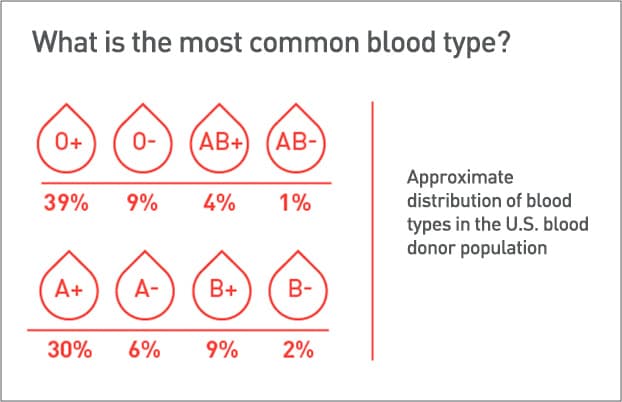
B+ is the third most common among the 8 blood types
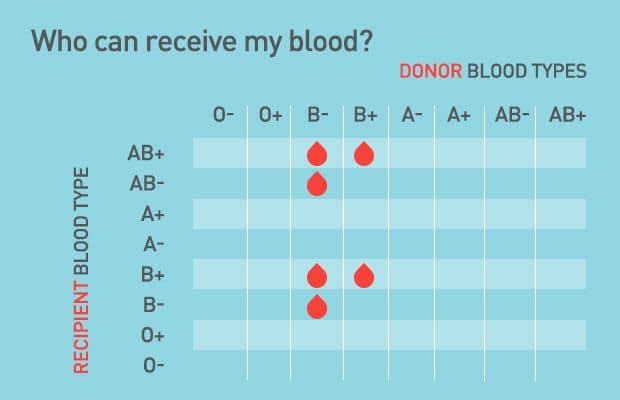
- Your blood can help patients with AB+ and B+ blood types.
- Your blood type is ideal for platelet donations, which you can donate every 7 days, and 7 days after a whole blood donation.

B- Blood Type
B- is the second most rare among the 8 blood types
- Your blood can help patients with AB+, AB-, B+ and B- blood types.
- Your blood type is ideal for a Super Reds donation. You donate just red blood cells through an apheresis (ay-fur-ee-sis) donation. This donation results in twice as many red cells for patients, and it allows you to come in to donate two times a year with the same impact as donating whole blood six times a year. Give it a try at your next appointment.
Facts and Figures: Type B Blood
Learn About Other Blood Types


Understanding Blood Type B: FAQ
What are the two types of B blood?
There are two types of B blood: B positive (B+) and B negative (B-). B+ is the third most common blood type, while B- is the second rarest among the eight main blood types.
Is B positive blood rare?
B positive blood might not be the rarest, but it’s definitely special. It’s found in only about 9% of the population, making it the third most common blood type. B positive donors can be lifesavers for people with B+ and AB+ blood types. Even more special, B+ blood type is perfect for platelet donations which is in constant demand for cancer and trauma patients.
What are some facts about B negative blood?
- B negative blood is found in less than 2% of the population, making it the second rarest blood type.
- B- red blood cells can be given to patients with B and AB blood types, regardless of their Rh factor.
What are the advantages of having B negative blood?
B negative blood is highly Important due to its rarity and compatibility. It can be given to patients with B+, B-, AB+, and AB- blood types, making it crucial for emergency situations and rare blood type patients.
What are some personality traits associated with blood type B?
While not scientifically proven, some believe that people with blood type B are outgoing, creative, and passionate. They are often described as curious, relaxed, and adventurous.
What’s the difference between B+ and B- blood types?
The main difference is the presence (B+) or absence (B-) of the Rh factor. B+ can receive blood from B+, B-, O+, and O- donors, while B- can only receive from B- and O- donors.
How important is B blood type for medical treatments?
B blood type is crucial for treating people with conditions like sickle cell disease and thalassemia who need frequent transfusions, especially in South Asian and Black communities where B blood type blood and these conditions are more common.


